A few months back, I wrote a post about Dorothy L Sayers and a personal friend of mine, Amy Marsland. I would like to continue the theme of women who inspire me by featuring a post about Madeleine L'Engle.
Years ago my mother discovered 'Walking on Water', and which I've been meaning to read for a long time. I finally managed to do so this spring. I was absolutely inspired! There was something on nearly every page which I ended up underlining to remember later. Her views on artists and Christianity were very freeing to me. L'Engle has a frank and inquiring approach to faith. Above all, I love her acknowledgement that we don't know everything, and mystery and uncertainty is just a part of life (I loaned my copy to my sister, so can't pull out any quotes).
I then moved on to the 'Crosswicks Journals'. I've read 'A Circle of Quiet' and have started the next in the series. I look forward to learning and being enlightened more by this wonderful woman.
Recently, whilst trawling google for a nice photo of L’Engle, I happened upon an article by a woman who came to the conclusion that since Madeleine L’Engle didn’t live the perfect life she portrayed in her ‘journals’, her views and truths were flawed and no longer pertinent for this particular author. Ever since reading that Article, I’ve been thinking about it, and wondering if knowing more about the flaws in L’Engle’s life has altered my assessment of her, or lessened the impact she’s had on my life so far this year.
It hasn’t.
What has Madeleine L’Engle done for me this past year? She’s helped me feel more comfortable in my own skin as an author. Sure, I haven’t published a book *yet*. My blog and my instagram accounts aren’t followed by thousands of people. But I write every day. I want to be a published author. I want that to be my job. But I know I’ll write anyway, whether that ever happens or not.
I am happier in my religion. I can now acknowledge that there will always be doubts. There will always be mystery. Yet that strengthens my belief, instead of weakening it.
I feel that I understand my mother (a published author, biographer and poetess Susan Evans McCloud) much better. All creative people fabricate their own world around them, and in recognising that in Madeleine and in myself, I feel I understand my mother a lot better than I did before.
Life is full of paradox, pain, joy and pleasure. Accept it all. It will help you become a better person, and, more importantly, a better creator.
Thank you, Madeleine.
Thursday, September 21, 2017
Friday, September 8, 2017
Summing up the Summer
Busy writing. I've written 27,360 words since the beginning of July.
I've never liked summer weather. Anything warmer than 75 Fahrenheit is just too hot. Why does all my family have to live in Utah, then? Even having a birthday in August (and I quite like my birthdays) doesn't help.
Summers are inevitably busy. I was able to begin a few (read: too many) projects, and I have written quite a bit in my current first draft, so that's a relief. Here's a visual of some of the projects I've begun, and which I hope to finish if not by the end of this month, then by the end of October.
Working on a new 1910scorset pattern from Scroop Patterns
As well as. A 1920s robe de style-type dress from Past Patterns
As well as a 1910s suit pattern (see photo below) from Wearing History
I'm working on a 1910s blouse from Wearing History as well, but that's not pictured. That's a lot of sewing projects! Wish me luck!
Monday, August 7, 2017
If the shoe fits...Royal Vintage Shoes!
I still consider myself a novice in the historical costuming world. In the four years I've been sewing I've learned so much, and know I still have a lot to learn. One of my delightful discoveries is that the seasoned seamstresses out there are very generous, and happy to help those who, like myself, are still learning.
Sadly, like most passions, costuming takes quite a bit of money. For circa 1920s-1950s there are quite a lot of fairly close replicas out there for $40 or so. But they're cheaply made, and sometimes, quite uncomfortable.
The charming and talented Royal Vintage Shoes is the perfect answer to this. They collect perfect shoes from the '20s-'50s that are high quality and accurate. They also produce their own shoes which are *gorgeous*. I'll show an example of some below:
They are more expensive, undoubtedly. But they're worth it! They're made with real leather and the quality is undeniably excellent. There is also a lot of research behind them. Some other advantages include pre-order discounts (which is going on right now -- through the 10th of August) and layaway plans!
There's also an awesome give-away going on right now!
Their joint company, American Duchess also has drool-worthy shoes from earlier eras, Renaissance through the 1910s. I know I'm preaching to the choir to those of you who visit this site who already historical costumers. But if there are any new-comers here, I hope you'll see the light as I eventually did, and start your collection of perfect, beautiful vintage shoes!
Sadly, like most passions, costuming takes quite a bit of money. For circa 1920s-1950s there are quite a lot of fairly close replicas out there for $40 or so. But they're cheaply made, and sometimes, quite uncomfortable.
The charming and talented Royal Vintage Shoes is the perfect answer to this. They collect perfect shoes from the '20s-'50s that are high quality and accurate. They also produce their own shoes which are *gorgeous*. I'll show an example of some below:
Eve Art Deco Sandals
Marilyn 1940s Pumps
They are more expensive, undoubtedly. But they're worth it! They're made with real leather and the quality is undeniably excellent. There is also a lot of research behind them. Some other advantages include pre-order discounts (which is going on right now -- through the 10th of August) and layaway plans!
There's also an awesome give-away going on right now!
Their joint company, American Duchess also has drool-worthy shoes from earlier eras, Renaissance through the 1910s. I know I'm preaching to the choir to those of you who visit this site who already historical costumers. But if there are any new-comers here, I hope you'll see the light as I eventually did, and start your collection of perfect, beautiful vintage shoes!
Friday, August 4, 2017
Favourite Era (with some extant examples)
I've recently joined a blogging challenge for August: Costume Blog Writing Month, to blog every day. I don't think I'll manage every single day in August (obviously, as I've already missed the first three days). But I will try to do several of the prompts.
Yesterday's challenge was extant garment. I thought it would be fun to combine that with today's challenge: Fave Friday: Favourite Era. I've done several posts featuring my clothing collection, and several of my posts deal with my favourite era, it this will be a fun opportunity to unabashedly focus on it.
Though I have a great love for many eras, my favourite is the 1910s. I don't know if this stems from my preoccupation with the First World War, or The Great War, as it is known in the UK (a fascination which has haunted me for over fifteen years) or if the fashion merits alone would have caught my eye.
The 1910s is often credited with drastic change from the beginning of the decade to the end. Certainly the early teens is softer, more feminine, with a hint of that Edwardian gentility still evident in the styles:
| The challenges for each day this month! |
Yesterday's challenge was extant garment. I thought it would be fun to combine that with today's challenge: Fave Friday: Favourite Era. I've done several posts featuring my clothing collection, and several of my posts deal with my favourite era, it this will be a fun opportunity to unabashedly focus on it.
Though I have a great love for many eras, my favourite is the 1910s. I don't know if this stems from my preoccupation with the First World War, or The Great War, as it is known in the UK (a fascination which has haunted me for over fifteen years) or if the fashion merits alone would have caught my eye.
The 1910s is often credited with drastic change from the beginning of the decade to the end. Certainly the early teens is softer, more feminine, with a hint of that Edwardian gentility still evident in the styles:
| From The Modern Priscilla, January 1911 |
By the mid-1910s, the style had definitely loosened. It began to move away from the ornate, and a mannish military look was in evidence, which is no surprise, as War always influences fashion.
Blouses and skirts. More simple and practical. From a 1915 Gimbel's Catalogue reprinted by Dover books.
So, what is it about the 1910s that I love so much? I think it is that balance between femininity and practicality. It isn't over-the-top like late Victorian fashion, nor yet as utilitarian as the 1940s (also influenced by war). Plus, they knew how to use buttons in both a useful and decorative way.
An original blouse from the mid to late 1910s, and a skirt from around 1917.
Notice the lovely tassel detail from the blouse? Also my fabulous London Oxford's from American Duchess.
Some more detail of the blouse.
This is a dress I made from a reprinted 1917 or '18 dress pattern.
A skirt and blouse I made from Wearing History patterns, paired with a modern cardigan.
Monday, July 24, 2017
Late 1930s Dress
It seems a long time since I've completed any sewing projects, and it's been so satisfying to finally get something done!
Last year, a friend of my sister's was getting rid of a large amount of her vintage pattern collection, and although I favour the 1910s, I acquired quite a few patterns from the 1930s through the 1950s. A few months ago I decided to go through my stash and try out this charming dress (seen above) from the late 1930s.
I've been a little baffled by vintage patterns, and their sizing. I've finally realised that the bust measurements must have been taken under the bust (like bra sizing), and not across the bust as I'd always assumed.
Otherwise the pattern was pretty simple to put together, and is a very comfortable and pretty dress. I decided to simplify the trimming, and only used the white pleated ribbon on the neckline. I also modified the sleeves. I shortened them, and made an inverted pleat instead of gathers.
A view of the shorter, simplified sleeves.
The completed dress!
A close-up of the neckline.
Friday, July 14, 2017
The Educated Woman: Dorothy L Sayers & Amy Marsland
I've been in a bit of a funk lately, since returning from my trip to the UK. Various thoughts and decisions that I'll have to make in the next little while have been troubling me. So I've been thinking about some of the women who inspire me, and wanted to write a few posts dedicated to them.
When I was about twenty years old, give or take, I discovered the BBC series of Lord Peter Wimsey starring the delightful and ineffable Ian Carmichael. I fell in love. Over the course of the next few years, I read several of the Peter Wimsey mysteries, a biography of Dorothy L Sayers, and her translations of Dante's 'Divine Comedy'.
My favourite of her mysteries are those which introduce and feature Harriet Vane, and the evolution of her characters is masterful. I am always daydreaming that the BBC or ITV will do a new series (please?!), the last ones - starring Edward Petherbridge and Harriet Walter as Peter and Harriet - having been filmed in the late 1980s! Still waiting on that one.
The novel 'Gaudy Night' is a very moving and beautiful book. When I lived in upstate NY, I knew an incredible woman, Amy Marsland. When I met her, she was in her eighties. She wrote articles for the local paper, knitted and baked delicious shortbread cut in all different shapes. She was a bright, intelligent woman, and a joy to know. She was very well educated, receiving her MA and PhD at the university of Michigan. She wrote mysteries herself, as well as scholarly work, and she and her husband lived both in Europe and America throughout their lives.
My sister ran a book club at Moore Memorial Library, in Greene, New York, and Amy was a member of this group. One month we read 'Gaudy Night', and it was incredible to hear her perspective on the novel, which she first read as a young woman in the 1940s.
As well as a puzzling mystery, 'Gaudy Night' deals with a lot of issues women faced in the early 20th century: education, academic integrity, and working, and/ or being a wife and mother. She told us that these were all issues she was dealing with and trying to sort out in her life, and that 'Gaudy Night' was a great inspiration to her.
The wisdom it contains is a continual inspiration to me, it's a novel I've read several times.
My favourite quote from the novel is as follows:
"If one's genuinely interested one knows how to be patient, and let time pass...If you truly want a thing, you don't snatch; if you snatch, you don't really want it."
When I was about twenty years old, give or take, I discovered the BBC series of Lord Peter Wimsey starring the delightful and ineffable Ian Carmichael. I fell in love. Over the course of the next few years, I read several of the Peter Wimsey mysteries, a biography of Dorothy L Sayers, and her translations of Dante's 'Divine Comedy'.
| Portrait of Dorothy L Sayers by Sir William Oliphant Hutchison National Portrait Gallery |
My favourite of her mysteries are those which introduce and feature Harriet Vane, and the evolution of her characters is masterful. I am always daydreaming that the BBC or ITV will do a new series (please?!), the last ones - starring Edward Petherbridge and Harriet Walter as Peter and Harriet - having been filmed in the late 1980s! Still waiting on that one.
The novel 'Gaudy Night' is a very moving and beautiful book. When I lived in upstate NY, I knew an incredible woman, Amy Marsland. When I met her, she was in her eighties. She wrote articles for the local paper, knitted and baked delicious shortbread cut in all different shapes. She was a bright, intelligent woman, and a joy to know. She was very well educated, receiving her MA and PhD at the university of Michigan. She wrote mysteries herself, as well as scholarly work, and she and her husband lived both in Europe and America throughout their lives.
| Amy as a young woman in the early 1940s, when working on The Sheaf newspaper at the University of Saskatchewan. |
My sister ran a book club at Moore Memorial Library, in Greene, New York, and Amy was a member of this group. One month we read 'Gaudy Night', and it was incredible to hear her perspective on the novel, which she first read as a young woman in the 1940s.
As well as a puzzling mystery, 'Gaudy Night' deals with a lot of issues women faced in the early 20th century: education, academic integrity, and working, and/ or being a wife and mother. She told us that these were all issues she was dealing with and trying to sort out in her life, and that 'Gaudy Night' was a great inspiration to her.
The wisdom it contains is a continual inspiration to me, it's a novel I've read several times.
The book club at the library. My sister is on the far left, and I'm standing next to her. Amy is two over to the right, wearing a pink/ salmon outfit.
My favourite quote from the novel is as follows:
"If one's genuinely interested one knows how to be patient, and let time pass...If you truly want a thing, you don't snatch; if you snatch, you don't really want it."
Thursday, June 22, 2017
St. Ninian's Point, Isle of Bute
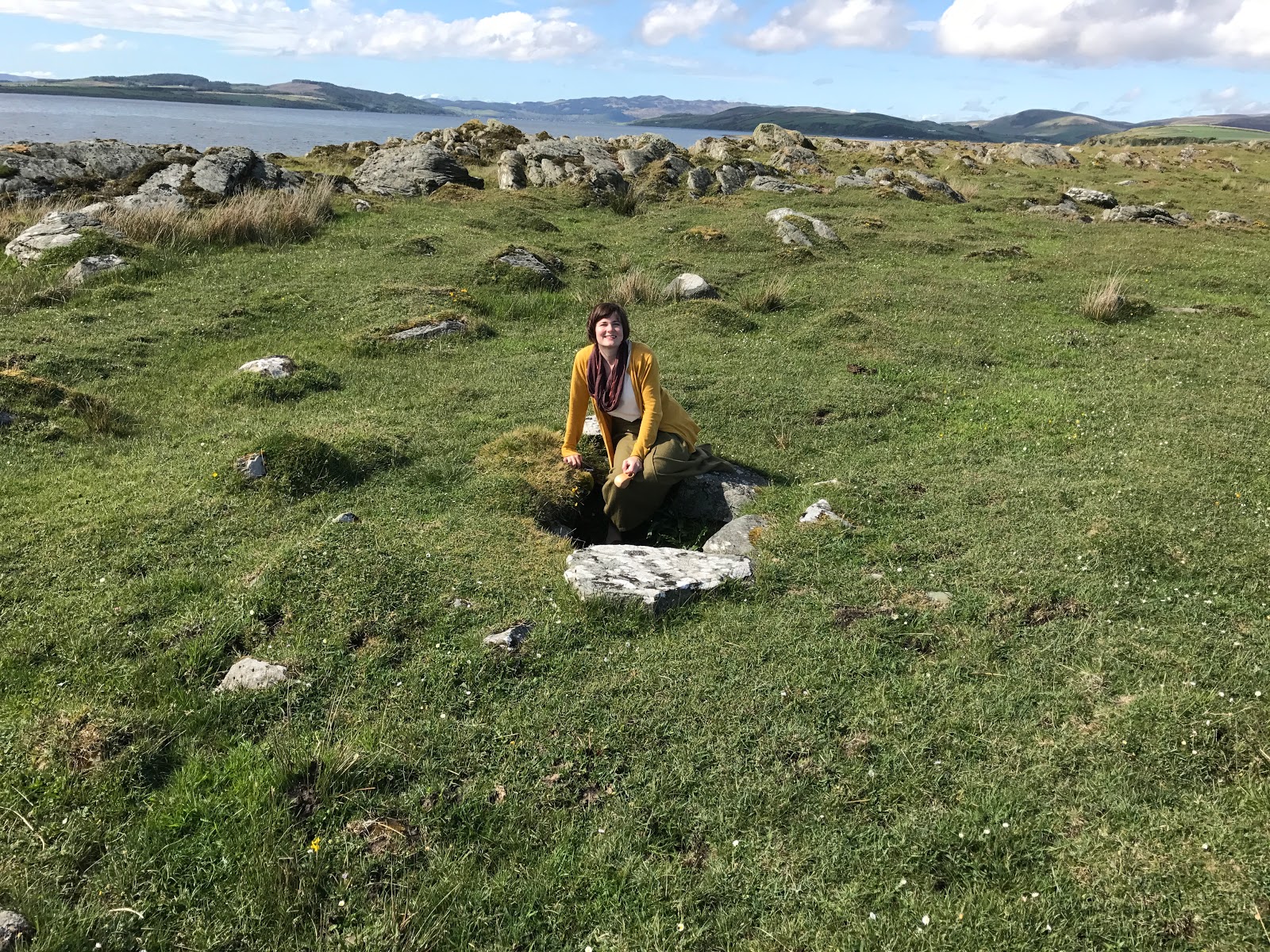
Again, I was on a quest to hunt down a couple of holy wells, this time at Ninian's Point, on the west coast of the island.
On the walk out to Ninian's Point.
"Big cloud tumbling high, the amazing flying sky..." Donovan songs are rather apt for describing
island life.
The remains of a chapel, with circular enclosure, are found on the western tip of the point, dated to the 12th century. In this area, between the chapel remains, and the shell of a much later kippering house, are the wells in question. Neither seems to have an associated name, but their close proximity to the church could mean they have a significant if not holy presence there. I found both, one of which had steps leading down into the well, and may have been used for baptisms. I brought my cup with me, but alas, the water in both these wells was still and scummy, and I did not attempt to drink it.
The larger well, with steps.
A close-up of the unappetising water!
The smaller well. Perhaps one was holy, and one used just for water. It is possible, though, that they both had holy functions and were part of a complex involving the church.
I'm so glad my friend Rachel was able to come with and share my adventures. I appreciate all the pictures she took of me too!
It was a beautiful day, and the constant sound of water could be heard lapping the rocks. I felt like I was in Enchanted April.
Subscribe to:
Posts (Atom)