Tuesday, February 22, 2022

Circa 1912 Wool Dress

 A few weeks ago I found a really wonderful early 1910s dress. It is wool with silk accents on the cuffs and collar. The buttons are fabric-covered, rimmed with what looks like an early plastic. I was able to get it for a very good price. It's a rare thing to find an example of this type of dress. 


Cream-colored wool dress.


Fashion plate from 1912/1913


Here's a long view of the front and back of the dress. There is some moth damage, but otherwise it's in excellent shape. Structurally, it's very sound. 


The back of the dress. It's a little hard to see but the skirt has a wonderful middle panel. 

The dress is full of beautiful details. It's fastened up with hooks & eyes, the buttons do fasten but are mostly decorative. Notice the nice finishing work under the collar. 

A view of the inside waistband and how it all hooks together. 


Look at the lovely pleating in the bodice. 

It's wonderful to be able to find pieces like this. You can learn so much about the construction of clothing this way. There are original dress patterns available, and even using these, it helps so much to see an original dress to figure out what the finished piece should look like. 

I'd love to draft a pattern off this dress, but that's not a skill I've developed yet. Maybe this would be a good time to learn. There are some wonderful companies that sell 1910s patterns, here are some of my favorites: Wearing History, Vintage Pattern Lending Library, Past Patterns and Fashion Archaeologist

Tuesday, February 15, 2022

Museum of Rexburg


The Rexburg Tabernacle. The Museum is in the basement of this building.

It is a huge blessing that I was able to find a job at the Museum of Rexburg. I've been working there since June, and it's always interesting, and I have wonderful coworkers. A large focus of the museum is the Teton Dam Flood, an event that happened in 1976, when a brand new dam, nearly filled for the first time, broke and a large area was flooded and severely damaged. During the summer we ran a mini escape room related to that disaster, and we are always working on photos, slides, newspapers etc. relating to it. 

My favorite part of the job is being able to work on the clothing collection held by the museum. I've been impressed by the clothing that people have worn in Rexburg since it was settled in 1883. It's a pretty rural spot, so it proves that people (especially women) have always found it important to be fashionable and beautiful. 

A beautiful early 1900s dress that got donated last year. I had a guimpe (a dicky-type thing) that I'm loaning to the museum while this piece is on display, so that it has that proper undershirt. This is the display at Christmas time. 

Another exciting project we were able to all work on for this past Veteran's Day was to catalog all the military uniforms that we had in our collection. Again, I was surprised by how many uniforms - especially from the 1st World War - we have in the museum. 

Studying a tunic from the early 1900s (pre-WWI)


The mini display with uniforms & a slideshow highlighting some of the Rexburg citizens who have fought in wars through the years. 


For winter this year, we all worked on a new display on winter sports & winter wear etc. in Rexburg through the years. It was a really fun project to work on. 

Vintage coats, skis, mittens, snow shoes & other winter delights.


For more information on the museum and the Tabernacle, check out this link.


Tuesday, February 8, 2022

The BYU Idaho Special Collections & A Book of Hours

The reverse side of a page from a Book of Hours.

A few weeks back, I arranged a mini field trip to the McKay library for my Book Arts class. I have not taken advantage of other universities special collections much, but though the BYUI collection may be modest, they do have some beautiful antique books in their collection, and what's more, they have a hands-on policy which is delightful. 

It was wonderful for me to see Medieval books, and a delicate, tiny page from a Medieval Book of Hours. I've been fascinated by  for years, and Medieval manuscripts and illustration for years. One of the most well known is the Luttrell Psalter, which depicts everyday life in the 14th century really beautifully. Here is an article about it from the British Library where it is held. 

A closeup of one of the pages of the Luttrell Psalter, British Library


Here are a few photos from our visit to the Special Collections:

The front of the page from the Medieval Book of Hours (reverse side seen above).


They had non-paper examples of 'books' as well.

I really appreciated how they included a sampler as a written form of expression too.


I feel really lucky to have this resource available to me, and plan on going back to further study the books in their collection. I've also felt inspired since this visit to make my own Book of Hours (a more modest version of one), so we'll see! 

A sketch I made to put into my Book of Hours.


Tuesday, February 1, 2022

A Little bit of Art

One of my first transfer drawings.


When I was a teenager and first taking college classes, I wanted to be an artist. I took several art classes at the local college, until one day when a successful artist was invited to speak to our class. I remember he told us that if we didn't eat, sleep, drink art, not to go into it, because it was a difficult path, and not usually a lucrative one. 

That guest artist had a profound effect on me. It decided me against studying art in college. I remember thinking at the time that I preferred writing to drawing and painting. Not that I then decided to go to school in English or literature, but that's a different story. 

When I was learning bookmaking, I also learned how to do transfer drawings/ transfer monotypes. Here is an article explaining transfer drawings. I made 15 drawings, which was quite the challenge for me. Since then, I've made maybe as many more. I still feel very tentative about it, but it's also exciting and fun to explore visual art again. Not to say that I never draw at all, but not as much as I feel like I have in the past year. It's been a good thing for me to stretch my creativity. My husband has been so encouraging and kind to me about these drawings, and I'm so grateful for that!

Here's a look at a few that I've done: 


This one was inspired by Julian of Norwich and her famous quote: "All shall be well, and all shall be well, and all manner of thing shall be well." 


I like the smudgy effect that laying the ink in paper makes. It adds texture and interest to the image. 


Tuesday, January 25, 2022

Book Arts


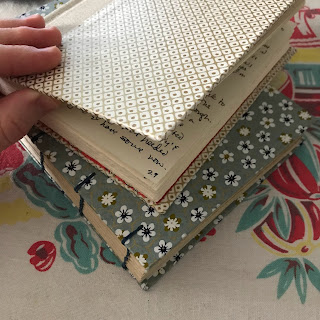
3 books with Japanese Stab binding


When I first moved to Rexburg, I was interviewed for an adjunct teaching job at BYU Idaho in the arts department, to teach Book Arts. This is a skill that I have only recently learned, and feel that I am still learning. I love books and the history of them. When I was studying archaeology, I learned that when monks in Scotland began making and writing books, the local population was amazed. It was a magical, powerful thing to them. It's exciting and challenging to teach students the art of making books, and the joy and magic of them as well. 

A book I made in the Coptic style, for one of my brothers-in-law
I used postcards with Shakespeare quotes for the decorative inside cover.


My first semester teaching coincided with my wedding - classes started the week after we were married. That was a crazy thing to do in hindsight, and there were some challenges during that semester. But I'm grateful for what I've learned, and for the chance to teach again this new semester.


I have some blank books that I've made that I've been hesitant to use, but just a couple weeks ago I decided to use one as a personal/ creative journal, and it has been really exciting writing in a book that I made by hand. 


The bound book I made which I'm  writing in, on top of another Coptic book.
The outside of the bound book. I think Coptic books are my favorite to make, but it's very satisfying to be able to make a bound book too. 


I'm grateful for the unexpected things in life: learning this new skill and having the opportunity to teach it at a university isn't something I necessarily planned in my life. I am blessed to be able to have two jobs where I can use my creativity, knowledge and passions. 

Tuesday, January 18, 2022

Making my own Wedding Dress

 So much has happened since I last posted on this blog, the most obvious being Covid. We all know how that has changed everyone's lives, I don't need to write any more about that! At first I was using Covid as an excuse to not keep up on my blog, but lately I've been feeling the itch to revive it and so here we are. 

Last year, in May, I moved from living with my mother in Utah, to totally living on my own (something I've never experienced before) in Rexburg, Idaho. I found a part-time job at the local museum (The Museum of Rexburg), and then, on September 18th, I got married! Both of these have been significant and exciting shifts in my life. 

I was going to wear an antique dress from the 1910s, but decided to make my own dress instead. I used a pattern from around 1938 or 1939 that I've used before for two different dresses. I have previous posts detailing these dresses: Late 1930s dress and the Darby O'Gill dress I re-created. I used this pattern because I knew it worked well and I was comfortable with it. I used the long sleeve option and lengthened the skirt as well. I also worked with real silk, something I've been too shy of doing before this. I was pleasantly surprised by how nice it was to work with. 


Years ago, even before Nick & I were dating, I bought a pair of American Duchess shoes on sale. I was determined that I'd be married in these shoes. So, when I was picking out the silk for my dress, I matched it to the flowers in the silk panel on the side of the shoes. It was a perfect match.


A progress image - the bodice pinned to the skirt. 


My husband Nick and I got engaged in March, and then I moved to Rexburg in May. He would come up to visit and work during the summer, and then we were married in September out in the desert in a beautiful location. A friend of ours years ago had built a labyrinth, based of the one in Chartres Cathedral, and this was the location of our wedding. 


The finished dress, right before driving out to the desert. 

Out in the beautiful desert. You can see my American Duchess shoes in this photo too.  

Nick and me on our wedding day.


It was a semi-elopement, but some of our friends and a few of my siblings came for the wedding.


Our friend Scott Samuelson. He designed and built the labyrinth and talked about the history of the labyrinth, as well as reading an epithalamion -- a wedding poem -- that he'd written just for us. 


We all walked the Labyrinth before the wedding.

Tuesday, June 30, 2020

1790s Stays

I’ve been drawn to the 1790s/ Regency era for a long time and have flirted with it off and on for several years. I looked up some ancestors of mine who lived in New England during this period of time and it inspired me to make an entire 1790s wardrobe. I am hoping to do it all by hand.

So far I have completed the transitional stays using a kit from Past Patterns, linen fabric, thread and wool binding. It was challenging and exciting and it took me between two and three months to complete them.

After sewing the boning channels, I began adding reed. 


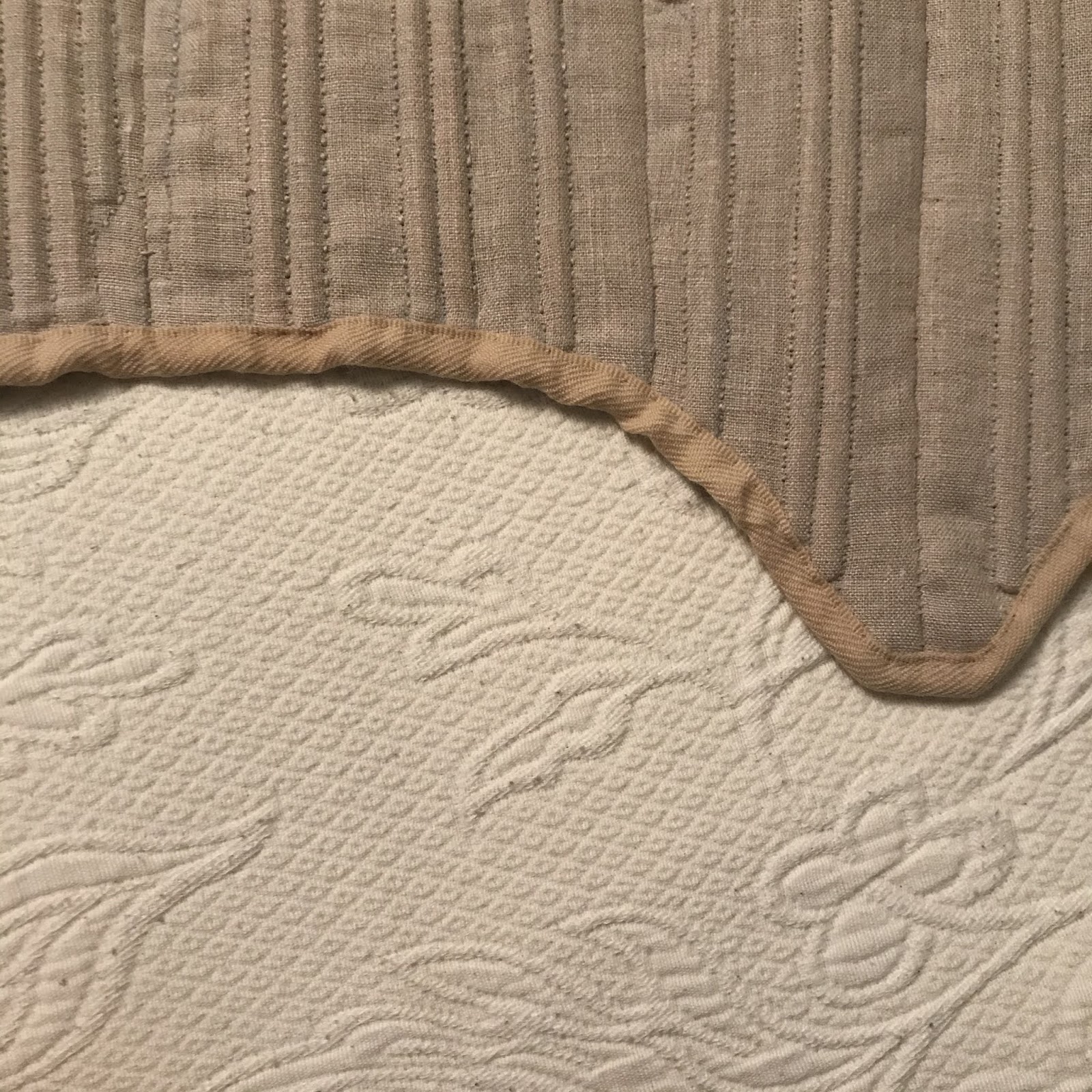
 A close-up of the wool binding & the boning channels. 

The back of the stays. 


A close-up of the hand-sewn eyelets & the binding. 


I have made some Regency-era dresses in the past, but they’re not entirely accurate. Until I have finished a dress to go with these stays, I tried on a dress my sister Heather made to see how these 1790s stays go with the Regency-era silhouette.