Tuesday, January 18, 2022

Making my own Wedding Dress

 So much has happened since I last posted on this blog, the most obvious being Covid. We all know how that has changed everyone's lives, I don't need to write any more about that! At first I was using Covid as an excuse to not keep up on my blog, but lately I've been feeling the itch to revive it and so here we are. 

Last year, in May, I moved from living with my mother in Utah, to totally living on my own (something I've never experienced before) in Rexburg, Idaho. I found a part-time job at the local museum (The Museum of Rexburg), and then, on September 18th, I got married! Both of these have been significant and exciting shifts in my life. 

I was going to wear an antique dress from the 1910s, but decided to make my own dress instead. I used a pattern from around 1938 or 1939 that I've used before for two different dresses. I have previous posts detailing these dresses: Late 1930s dress and the Darby O'Gill dress I re-created. I used this pattern because I knew it worked well and I was comfortable with it. I used the long sleeve option and lengthened the skirt as well. I also worked with real silk, something I've been too shy of doing before this. I was pleasantly surprised by how nice it was to work with. 


Years ago, even before Nick & I were dating, I bought a pair of American Duchess shoes on sale. I was determined that I'd be married in these shoes. So, when I was picking out the silk for my dress, I matched it to the flowers in the silk panel on the side of the shoes. It was a perfect match.


A progress image - the bodice pinned to the skirt. 


My husband Nick and I got engaged in March, and then I moved to Rexburg in May. He would come up to visit and work during the summer, and then we were married in September out in the desert in a beautiful location. A friend of ours years ago had built a labyrinth, based of the one in Chartres Cathedral, and this was the location of our wedding. 


The finished dress, right before driving out to the desert. 

Out in the beautiful desert. You can see my American Duchess shoes in this photo too.  

Nick and me on our wedding day.


It was a semi-elopement, but some of our friends and a few of my siblings came for the wedding.


Our friend Scott Samuelson. He designed and built the labyrinth and talked about the history of the labyrinth, as well as reading an epithalamion -- a wedding poem -- that he'd written just for us. 


We all walked the Labyrinth before the wedding.

Tuesday, June 30, 2020

1790s Stays

I’ve been drawn to the 1790s/ Regency era for a long time and have flirted with it off and on for several years. I looked up some ancestors of mine who lived in New England during this period of time and it inspired me to make an entire 1790s wardrobe. I am hoping to do it all by hand.

So far I have completed the transitional stays using a kit from Past Patterns, linen fabric, thread and wool binding. It was challenging and exciting and it took me between two and three months to complete them.

After sewing the boning channels, I began adding reed. 


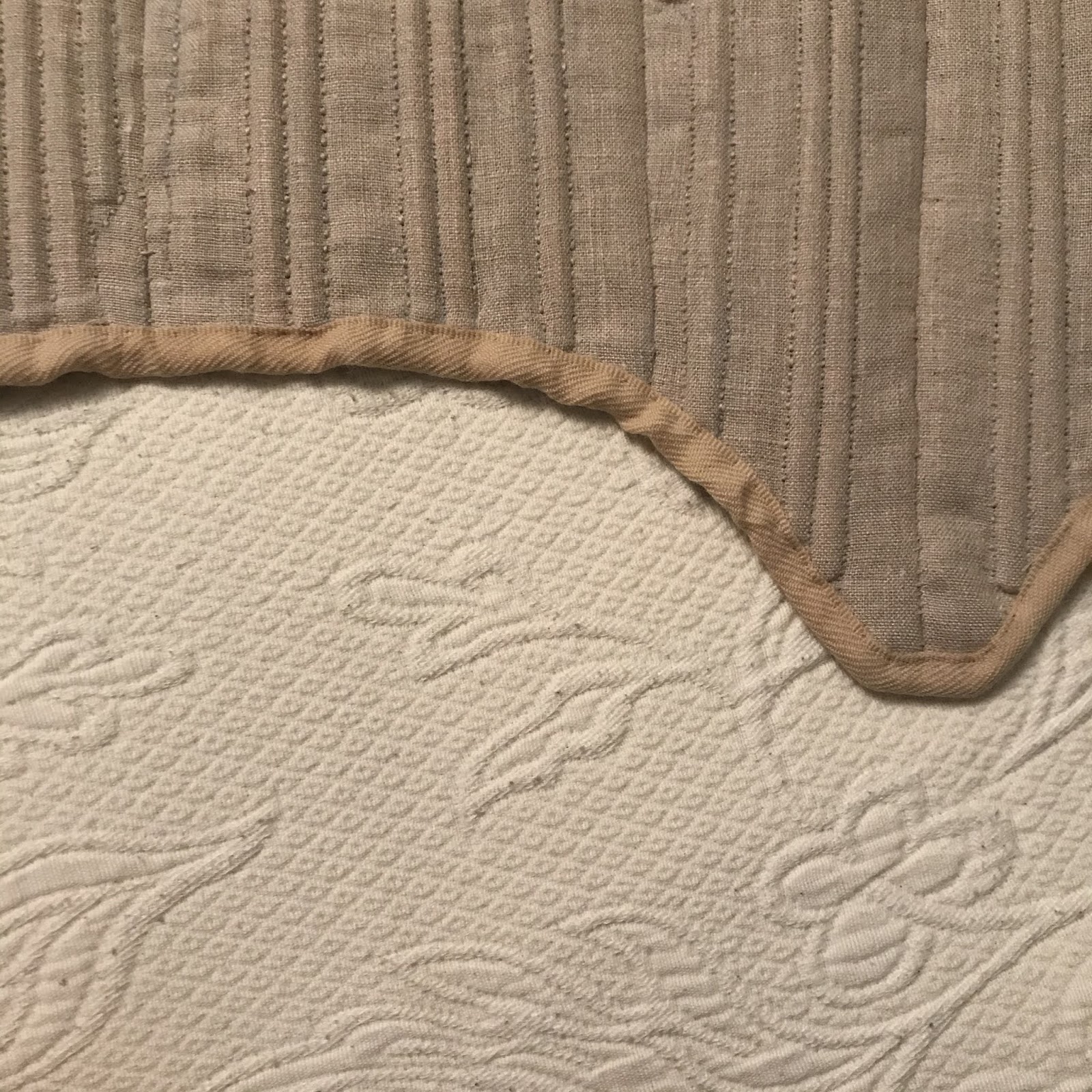
 A close-up of the wool binding & the boning channels. 

The back of the stays. 


A close-up of the hand-sewn eyelets & the binding. 


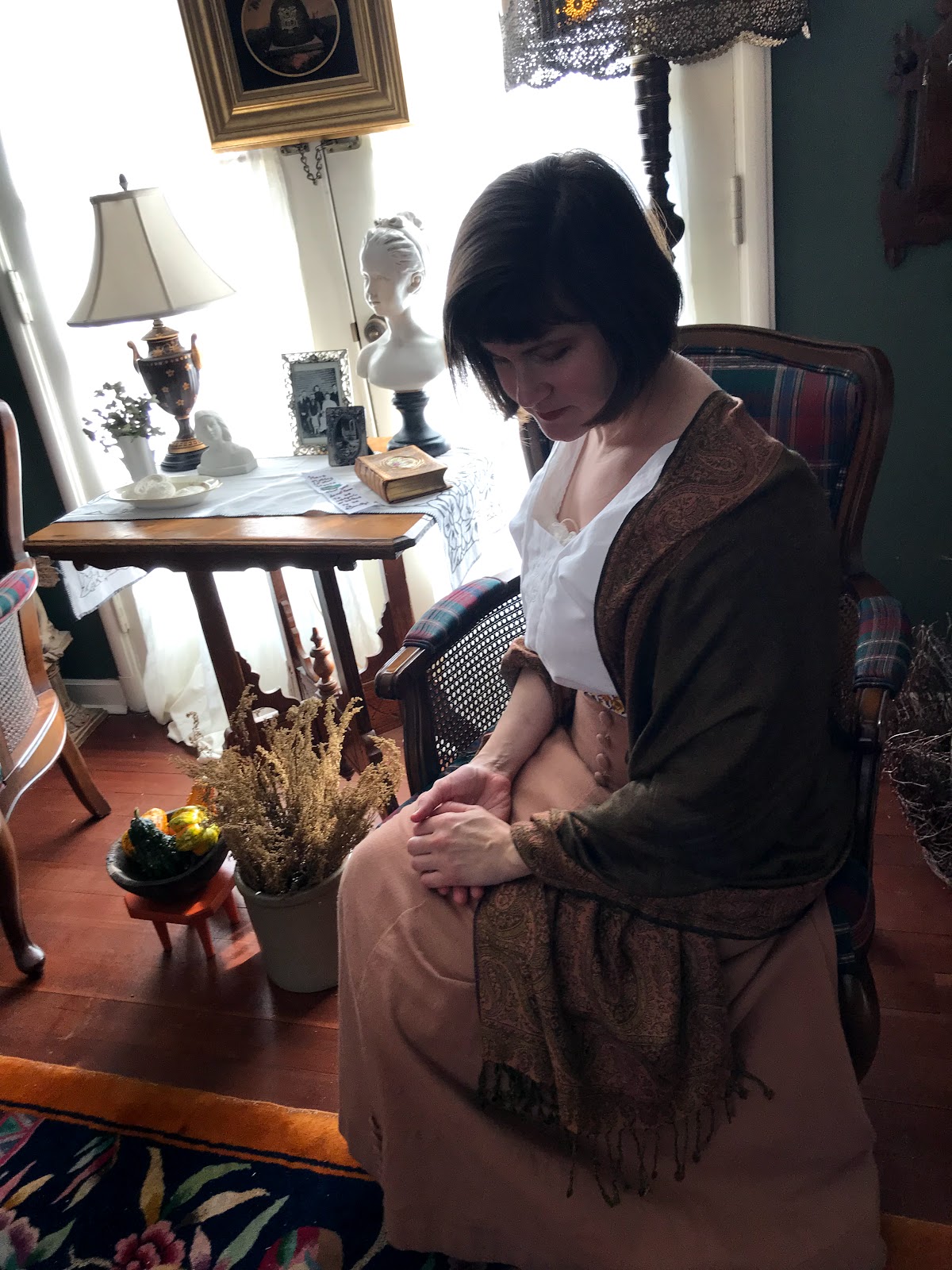
I have made some Regency-era dresses in the past, but they’re not entirely accurate. Until I have finished a dress to go with these stays, I tried on a dress my sister Heather made to see how these 1790s stays go with the Regency-era silhouette. 


Saturday, September 14, 2019

1910S Fashion My Style

For many years I've been intrigued by the history and literature of the 1910s. A few years back I started sewing my own clothing from that decade as well, and there are many wonderful pattern companies right now that offer either original patterns or ones inspired by the Edwardian era. 

A blouse & skirt made from 1910s patterns.
I have used patterns from Past Patterns, Ageless Patterns, Wearing History Patterns & Fashion Archaeologist (all available online and/ or on Etsy). 


At first, when re-creating these 1910s clothing, it was very important to me to look just right, and I made myself a 1910s corset (two actually, one from a Truly Victorian pattern & one from Scroop patterns). 

The first over-bust corset I made from Truly Victorian patterns

 
My second under-bust corset made from Scroop Patterns
I discovered, however, that one of the things I liked about 1910s clothes, at least the ones I was making (simple dresses, skirts & blouses) was how versatile they were, and fun to pair with modern clothing. 


Wearing 1910s clothing with a corset
 
An original 1910s dress worn with my under-bust corset
While it is fun (and actually pretty comfortable) to wear everything authentically with corset and all, I really enjoy being able to wear my skirts and blouses with modern pieces of clothing - and modern underclothing. While a 1910s corset isn't uncomfortable, it is a little stiff, and not practical for everyday use. 


Wearing a 1910s skirt with a modern blouse & cardigan (and lovely hat knitted by my friend) 
Another example of a 1910s skirt with modern clothing & accessories. So comfortable and versatile! 

I guess the purpose of this post is just to say that while it is fun and exciting to do things properly & accurately, it's also nice to be able to use historical clothing everyday and to be able to enjoy it in a casual way, not just when dressing-up. There is no right way to do vintage/ historical clothing, and I'm glad I've found an enjoyable way to wear my 1910s clothing. 

Friday, August 30, 2019

Agatha Christie Blouse

I have long admired the style of Agatha Christie, especially when she was a young woman in the 1910s and ‘20s. After the delightful recent adaptation of ‘Howard’s End’, my resolve to have a smart striped Edwardian blouse increased.

The inspiration for my blouse. 

I bought a pattern from Past Patterns, found a lovely striped cotton and set to work.

A closeup of the collar, which was a bit tricky! 


I liked the pattern, but it was a little difficult, and I mis-read the directions for the pleat/ tuck that goes around the shoulder. But I liked the look of my mistake so kept it.

The Norwich area is full of gorgeous churches and it was a nice plus to explore them in my 1910s outfit. The skirt is an original, from around 1917. 

I made the belt with some vintage ribbon, and the neck-scarf is from Burnley & Trowbridge. 


Sunday, August 18, 2019

It’s been a few months...

I hadn’t realized that nine months (!) has gone by since my last post. I have not been entirely idle, so this is one of a few catch-up posts to show what I’ve been up to. 


Rachel & me at her hen night/ bridal shower


In March, my dear friend Rachel was married. We met at church whilst we were both at uni, back in 2010, and though attending different universities, we became fast friends, and even shared a flat for three years. It was a wonderful opportunity to be able to travel to the U.K. in order to be there for her wedding. 

Before my trip, I made Rachel a temple dress. Rachel and I are both members of the Church of Jesus Christ of Latter Day Saints, and we have temple ceremonies, for which you wear a white dress. I didn’t feel up to making her wedding dress, but it was a delight to make her temple dress. 


I was terrified that it wouldn’t fit,  but luckily it did! 
What a huge relief!

Rachel’s wedding was a relaxed, quiet affair, and absolutely one of the best and most beautiful weddings I’ve ever been to! 

The bride and groom. So lovely!


Friday, November 23, 2018

WWI Centenary: Armistice Blouse

I had every intention this month, of being involved in all the WWI commemoration going on around the 11th. However, packing and preparing to move (and doing so on the 10th) proved to be more distracting than I had anticipated.

Surprisingly, though, and much to my delight, I was able to make a commemorative ‘Armistice Blouse’ in time to wear on the 11th of November itself! I used a simple pattern from Truly Victorian and embroidered the front panel with white poppies, inspired by a circa 1920s apron my sister Morag gave me for my birthday. The blouse is a little loose in the shoulders, and I hope eventually to make a guimpe to wear beneath it, but on the whole I’m very pleased with it. Here are some photos of the blouse!

A close-up of the embroidery. 

Showing off my gorgeous Royal Vintage shoes which I wore with my outfit. 

I made the skirt as well, a few years back, and the belt buckle is Edwardian, with vintage ribbon. 


The vintage hat I bought in Glasgow. 


Monday, November 5, 2018

WWI Centenary: Arthur Lang

This might be a funny thing to admit, but I am really gutted that I haven’t been in the U.K. during any of the Great War Centenary events happening in the last four years. Ever since a dear family friend introduced the war poets to us over fifteen years ago, I have been fascinated by the history (and the fashions!) of the 1910s.

As one hundred years since the Armistice approaches, I want to have my own remembrance observances.

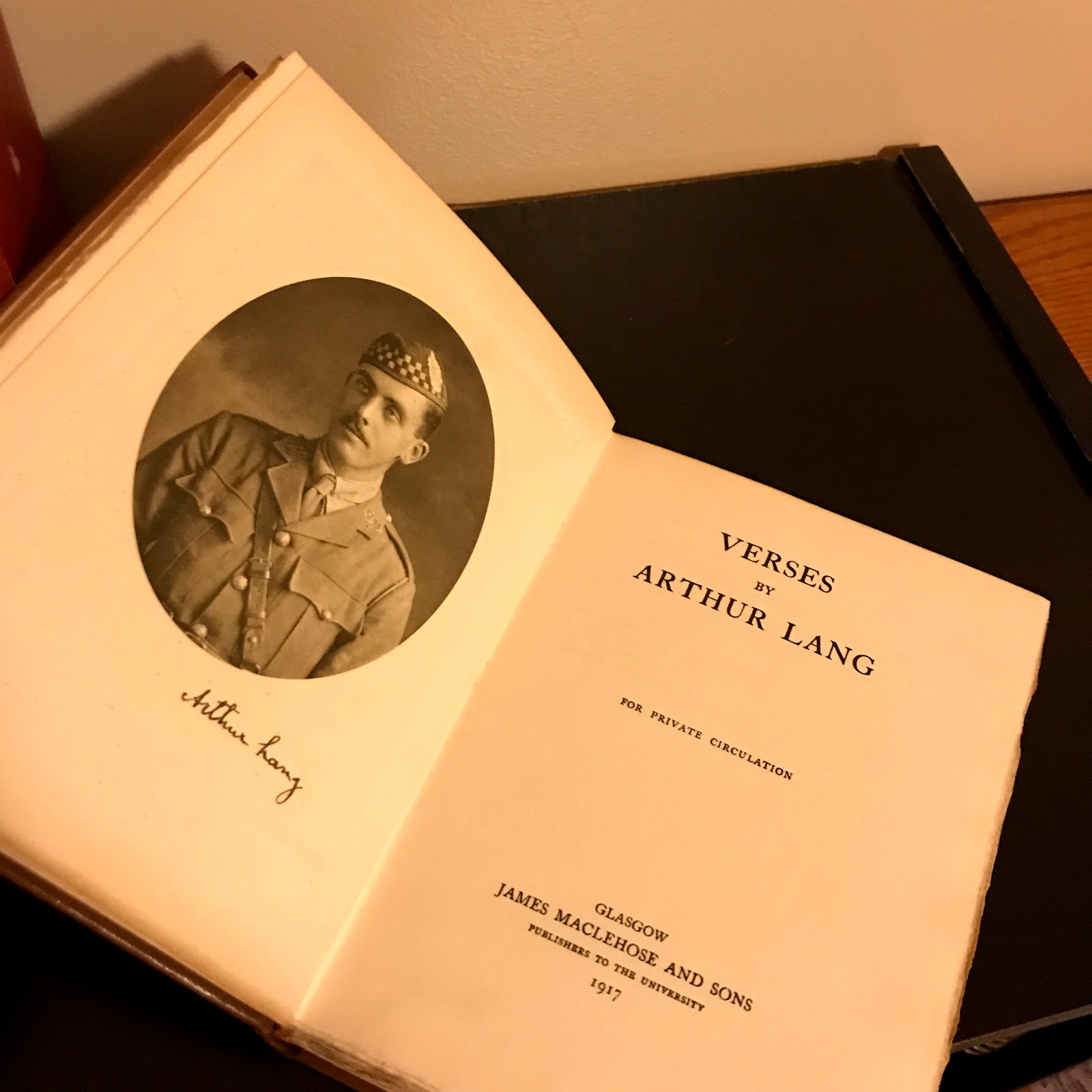
Whilst living in Glasgow, I would haunt the local charity shops, which are treasure troves of clothing, house items and books. In one on Great Western Road, the same road my flat was on, I found a slender volume of poetry published by the University of Glasgow. Of course I bought it.


Arthur Lang was born 16th April 1892. He attended the University of Glasgow from 1909 to 1913, before continuing his studies at Oxford. He joined up in September of 1914, and was killed in action 29th of August, 1916. 

These are the bare bones of this young man’s life. The University of Glasgow has more information on this friendly, talented fellow, which can be read here: Arthur Lang

Arthur Lang as a young man, from the University of Glasgow website (see above link)

Arthur as a soldier, as pictured in my book — ‘For Private circulation’

The tribute of him, given by two friends in the book, depict Arthur as a very talented, as well as a very friendly man. Though not best in large groups or parties, it seems as though his friendship was sought for and greatly cherished. He is not one of the great, remembered war poets of the First World War, but there are many such little known, worthwhile lives that were snuffed out in that conflict. 

A poignant discovery in my book: the card of Robert Lang, Arthur’s father. 

It’s incredible to me that this card, signed by the father and given to a friend, was still in the book when I found it for £1 in a charity shop, nearly one hundred years later.