Monday, March 7, 2016

Clothing Collection: 1910s Checked Dress

Again, I had my niece model this dress for me. 

Out of the collection that I acquired from my friend Tamara, this piece, though perhaps not the most beautiful, is one of the most intriguing. Elements of the construction are very interesting, and the fact that it boasts a Third Liberty Loan pin on the belt seems to seal it in time, and raise a lot of questions. 

It was well-loved and well-worn. It's stained. Judging from the size, I'm guessing it was worn by a teenager, though it is very spacious in the bust area, so perhaps for someone a little older. Or a large-busted girl!  Then at some point it was packed away, Third Liberty Loan button and all, and never worn again. Why? What is the story of the girl who wore it? Perhaps because I am so intrigued by the 1st World War, I wish I knew more about her. Did she lose a father, brother, or her young man? Any, or all three are possible, even in America, for we lost heavily enough in World War I despite our late involvement. When I took a class about poets of the 1st World War from the great Robert Means, he told us that the same amount of men were killed in a matter of months in the 1st World War, as were killed during the whole of Vietnam. 

Selvage and finished seams inside the waist.

I love that the print on the belt is larger than the rest of the dress.

Look at those stains!


I would date the dress as being made around 1914, though it could have been made later as well. The waist & sleeves are very similar to the 1914 pattern below (which you'll recognise from my last post, and which is available from Past Patterns):


Dress from 1914
Interesting sleeve construction!

I love the red buttons! And there's a glimpse of the 3rd Liberty Loan pin.

The Third Liberty Loan was a liberty bond sold from 5 April 1918. Many of them were sold by Boy and Girl Scouts. 


Examples of Third Liberty Loan posters. 


Filmstars of the time, such as Charlie Chaplin, Mary Pickford and Douglas Fairbanks also spent a lot of time promoting and selling war bonds. 

Left to right: Douglas Fairbanks, Mary Pickford & Charlie Chaplin selling war bonds. 


The waist and skirt are separate, but go together as a dress. 


A close-up of the Third Liberty Loan button.

Wednesday, February 24, 2016

Spring, 1910s Style

Is a post about Spring a little previous?
Edna St Vincent Millay in the 1910s

It's no secret that the 1910s has become my favourite style and fashion period. And although I make forays into the Regency era, and hope to make a few forays into the 1920s and '30s, I hope that I can just continue on this trajectory and have a lovely and complete 1910s wardrobe for all seasons. 

I think I mentioned in an earlier post that the recent film "Testament of Youth", the story of Vera Brittain, was one of the things that inspired me. Re-watching Downton Abbey with my niece has helped as well. 

One of the scenes in "Testament of Youth" was so lovely, and reminded me of pictures I had seen of the poet Edna St Vincent Millay - a contemporary of Vera Brittain's. 


Autochrome. I love it! Another shot of Edna St Vincent Millay.

Alicia Vikander as Vera Brittain in Testament of Youth (2014)

The dress of Edna St Vincent Millay's reminds me a lot of this dress, which is a pattern which can be found at Past Patterns.


I know the winter isn't over yet, but I'm sure we're all looking forward to the coming of spring. Especially if we can enjoy the blossoms on the trees! As for me, I'd better start sewing a 1910s dress for the spring! 


A 1910s Coles Phillips fade-away girl. She's enjoying the spring too!

Wednesday, February 3, 2016

Clothing Collection: 1910s Blue Wool Dress


Another item from my new 1910s collection is a petite dress of bright blue wool with lace and black velvet trim. I had my niece wear the dress (just for the pictures!) as it hangs better than on a dress-form (besides which, my dress-form is far too large for this dress!).

This dress has lovely ribbon, button and embroidery detail as well. 


Detail of the lace, ribbon and red buttons. 

Embroidery on the black lace belt. 
A view of the back of the bodice, with the beautiful lace collar. 

A full view of the back of the dress. 

The side-view, which shows black buttons on the sleeve.


I am still learning about the 1910s, but I would date this dress sometime around 1912-1914. The dress fastens up the front with snaps, along the side bodice and skirt. 


A dress from All The Pretty Dresses blog, from around the beginning of the 1st World War.

A fashion plate from 1914.

I am curious about a few things. There is a tag in the back of the dress, so it was store-bought. But I wonder if all the embellishments were original, or if some of them were added by the woman who wore this dress (such as the embroidery on the black velvet ribbon). The more I am able to study extant clothing, the more I will be able to tell, and I am so grateful for what I am already learning. 


A glimpse of how bright the dress was originally, compared to the worn outside fabric.

The tag at the back of the dress.

Wednesday, January 27, 2016

Clothing Collection: 1920s Silk Chevron Dress

Clothing advert from 1928

As a teenager I would visit my sister in upstate/ central New York every year for as long as I could manage. My favourite pastime was haunting the antique and vintage clothing shops of the area (Clinton Street in Binghamton used to have the best shops!). There was a small, run-down village near where we lived with a charming antique store called Extra Buttons. They had a little bit of everything. It was at this shop that I found this fabulous silk 20s dress. 


It's a very simple dress, typical of the boxy silhouette that typifies the 1920s - especially 1925-1930. There are nice little details, however. Some smocking at the shoulders and cuffs, and small buttons, which were once fabric-covered at the hips. 


The smocked sleeves with ties.

A tuck at the shoulder and smocking at the top of the sleeve.

This is an over-the-head dress, but there are snaps at the left shoulder to ease getting it on and off. 


Another wonderful feature of this dress is the pattern of the silk. It's a wild blue and light grey chevron design. 


Quite a large hem!

One of the side metal buttons. It had been covered in the same fabric, but it wore off. 

The other button.

The neck ruffle. 

The full view again. Isn't it a fabulous dress? 

Wednesday, January 20, 2016

Modern Priscilla: Bread Pudding

My niece has been baking bread like nobody's business, so bread has been on my mind. I was going to just throw together one when I thought I'd see if my Modern Priscilla cookbook had a recipe.

It did. I ended up combining two of the recipes, in fact.

I combined elements of the Bread Pudding & the California Bread Pudding recipes. 


Getting ready for the oven. I didn't put fruit & nuts in, but I did include vanilla & a bit of cinnamon.

Just out of the oven.


Trying a wee sample. I need to get some cream for when I serve it after dinner tonight. 


This recipe turned out well. It's simple & tasty - just the way I like a bread pudding. The bread is soft but not soggy. I did bake it at 325, and for probably 55 minutes. 


Wednesday, January 13, 2016

Clothing Collection: Early 1910s Blouse

Miss Lily Elsie, 1912.

I recently acquired an amazing collection of everyday clothing from the 1910s. The blouse I am going to feature, and a pair of drawers, came from Caldwell, New York (near Ithaca). My friend Tamara Manker Gates, who is an expert in the history of fashion, and of re-creating it, sent me this exciting collection. 

When I was in my teens, I indiscriminately bought anything that caught my eye, ranging from the 1910s to the 1950s. I've sold some of my old collection, and if I collect antique clothing, I'd like to focus on the 1910s and '20s only. 

The beautiful silk blouse from Caldwell, NY


I have not had much experience with drafting patterns yet, though I have attempted a few things. I am looking forward to the opportunity to learn from these pieces. 

In the early 1910s, the pigeon-breast of earlier times was still suggested in the silhouette, and the waistline was very high - echoing the fashions of a century before with the Empire/ Regency style. This blouse dates probably from between 1910 and 1913. 


Illustration by A Souchel

There are some really lovely features about this blouse: 

A stiff, gathered waistband

The back of the blouse

Small gathers at the front of the blouse


I've seen this detail (seen here on the sleeves, and on the collar as well) on another silk 1910s blouse in my collection. It is so lovely! Also note the hook and eye closure for the wrist.

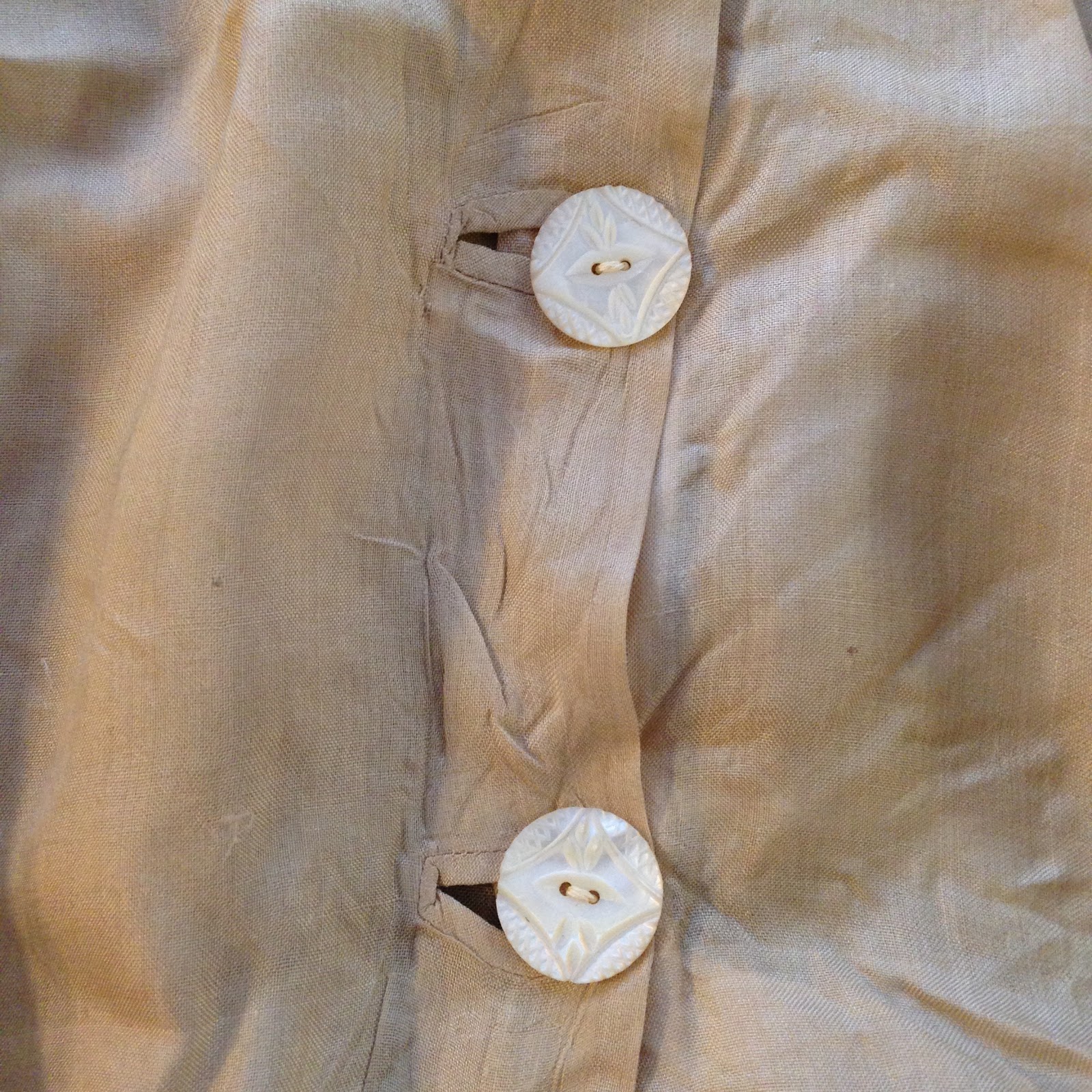
Beautiful mother of pearl buttons!

The front waist closure. Also with hook & eye.

It is a fairly simple garment, but so many of the small details are so incredible. It is a beautiful piece. Perhaps taking what I've learned from making a 1910s blouse, and drafting a pattern from this, I'll be able to make a copy - though I might not be able to do it in silk! Watch this space!